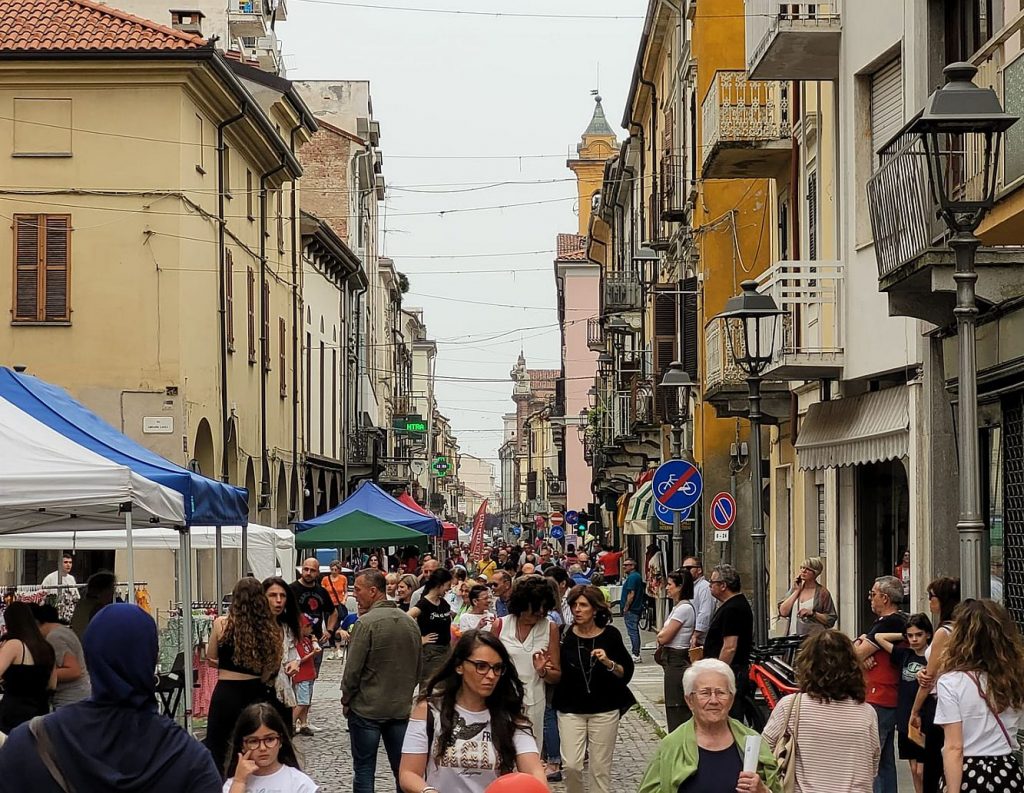
Nestled at the foot of the Monferrato hills, in the heart of the Vercelli plains and surrounded by rice fields and age-old paths, lies the town of Trino—an authentic gem in northwestern Italy, perfectly positioned between Milan and Turin. With ancient origins and a vibrant spirit, Trino’s roots stretch back to Celtic times, when it was known as Rigomagus, meaning “market of the king.” Over the centuries, it evolved into a Roman mansio, a strategic hub of communication routes, and a fortified settlement. Due to its key position, Trino became the stage for pivotal political and military events, and in the 17th, century was elevated to provincial status under the rule of the House of Savoy.
Walking through the town center, one breathes in the understated elegance so typical of Piedmont. In Piazza Garibaldi stands the majestic Palazzo Paleologo, built beginning in 1152 by Guglielmo the Elder and once home to the court of the Marquisate of Monferrato. Within its walls have passed popes, emperors, and noble families, and to this day it preserves rare Moorish decorative elements found nowhere else in the region.
Trino is a true treasure trove of artistic and spiritual heritage. The Church of San Bartolomeo, dedicated to the city’s patron saint, houses works by Gerolamo Giovenone, Orsola Caccia, Pier Francesco Guala, Luigi Morgari, and other esteemed artists. The evocative Santa Caterina d’Alessandria, once part of a Dominican convent, still safeguards the relics of Blessed Maddalena Panattieri and opens onto a refined 15th-century cloister. Just outside town, the Romanesque San Michele in Insula captivates with its millennia-old frescoes and a profound sense of peace. The G.A. Irico Civic Museum chronicles Trino’s long and layered history—from prehistory through the Paleologi dynasty and into the town’s Renaissance-era prominence in the art of printing.
A few miles from the center, two iconic landmarks symbolize Trino’s deep connection to nature and monastic labor. The Bosco delle Sorti della Partecipanza, now a protected natural park, is a rare remnant of the ancient lowland forests that once blanketed the Po Valley. Managed collectively since the 13th century by local “participants” under a hereditary system still active today, the forest reflects a unique model of community stewardship. Adjacent to it, the imposing Abbey of Lucedio—founded in the 12th century by Cistercian monks—is the birthplace of rice cultivation in Italy, a tradition that continues to sustain the region’s economy to this day.
With its sixteen churches, noble palaces, and the rich legacy of a once-thriving Jewish community, Trino offers an artistic and cultural heritage that far exceeds the expectations for a town of its size.
It is from this wealth—of history, people, and place—that our community draws its pride. Every time our players step onto the field, they wear more than just a jersey. They carry with them the colors of a noble past, the values of a hard-working community, and the strength of a territory like no other.
Through soccer, we aim to tell Trino’s story far beyond its borders—becoming ambassadors of culture, beauty, and tradition, as well as of the culinary and human excellence that make this land so special. With the support of local organizations that believe in the LB Trino project, we are building a network that champions not only the sport, but everything that surrounds it.
Because Trino is more than just a place—it is identity, inclusion, passion, and the spirit of a team.